Doctor Sot’s Slieve Bo outreach visit and crash
Dark Lies the IslandDoctor Sot’s Slieve Bo outreach visit and crash is a winter journey in which a doctor’s attempt to reach an isolated travellers’ camp gradually loses its professional boundaries and ends with his car in a ravine. The journey brings his headaches, whiskey use, and visions into the same frame as his work: he travels as a representative of the North Western Health Board, but becomes a guest who drinks with the camp and spends the night there after Elizabeth is wrecked. The visit’s final encounter with Mag, appearing in a mirror, leaves the episode suspended between hallucination and the unexplained.
Background and Departure
In late January, Doctor Sot’s headaches return. He drinks John Jameson whiskey to keep them in check and hide the naggins in his leather satchel, replenishing them often enough that he varies which off-licence he uses. He believes the piercing winter weather brings on the pain, and that the headaches often presage visions. His eleven-year-old Renault Megane, which he calls Elizabeth after his mother, is a companionable but underpowered presence in the cold; he speaks to it as if it were a trusted companion.
The episode places the journey within a broader picture of Doctor Sot’s medical work and isolation. His afternoon surgery is slow, attended mostly by elderly and fatalistic patients. Among them are people dealing with bereavement, persistent voices, and long-standing distress. His own headaches ease while he is working, but he avoids looking toward the white sky, since skies and mirrors are the settings in which his visions appear. This makes the outreach trip more than a change of workplace: it carries him away from the routines that briefly contain his symptoms and into terrain where his professional role will become less definite.
After prescribing a week of Valium and a new hobby to a patient who describes himself as being in a state of constant excitement, Doctor Sot tells Sal he is leaving on a mission. He calls it outreach, promises to return for tea, and sets off. Sal’s affectionate farewell contrasts with the growing uncertainty of the journey: what begins as an ordinary departure from home will leave him stranded overnight.
The Route to the Camp
Doctor Sot turns from the main road onto a side road, then follows a boreen that narrows into tracks and finally a rutted half-track. The route climbs into the high country, where his Megane labours. The landscape opens around him: the grey and shale tones of the mountain appear more radiant at close quarters, while turloughs glisten in the valley and gorse holds the bronze colour of winter. The change in scale and setting marks his distance from the surgery and the familiar roads of town.
The travellers’ camp announces itself through barking dogs. Its makeshift structures include tarpaulin shelters, old caravans, a horse trailer with a smoking chimney, a generator set inside something like a teepee, and a rainbow-coloured van. Doctor Sot introduces himself by his full professional name and the North Western Health Board, announcing the purpose of his visit. The young man who meets him gives his name as Joxie and explains that his full title is Joxie The Rant. The formal introduction meets an unfamiliar social world, but the travellers do not reject the visitor: they offer him green tea and make room for him in the back of the horse trailer.
Outreach Becomes Participation
Doctor Sot has not prepared as thoroughly as he thinks he should have. He wishes he had studied the leaflets and learned more of the travellers’ language, but they are friendly despite his uncertainty. His conversation with Joxie includes practical health advice, including a recommendation to eat oily fish such as mackerel for its Omega 3. Joxie answers with a joke about ground control, and the exchange establishes an informal tone in which medical instruction is neither ignored nor treated as a formal consultation.
The visit is not an official outreach session so much as an attempt to break the ice. Doctor Sot takes out a full naggin from his satchel and offers to strengthen the tea, presenting the whiskey as medicinal. That gesture shifts the encounter further from clinical work: the doctor’s hidden supply becomes a means of joining the gathering. Joxie asks whether others know Doctor Sot is out and about, a question that quietly puts his absence from home and the accountability of his mission into view.
When Joxie mentions that a woman has one of her spells on, Doctor Sot asks what he means, but receives no explanation. He drinks to brace himself, then drinks faster. As the travellers come and go from the horse trailer to attend to children and dogs, smoke roll-ups, and sip lager and cider, the visitor becomes less central to their conversation. They discuss dinner, getting the van repaired, and the significance of the number 23. Doctor Sot fetches more Jameson from Elizabeth. The visit’s intended focus on health gives way to the camp’s own rhythms, while the doctor’s growing intoxication makes him increasingly an observer and participant rather than the person directing events.
Crash and Night at the Camp
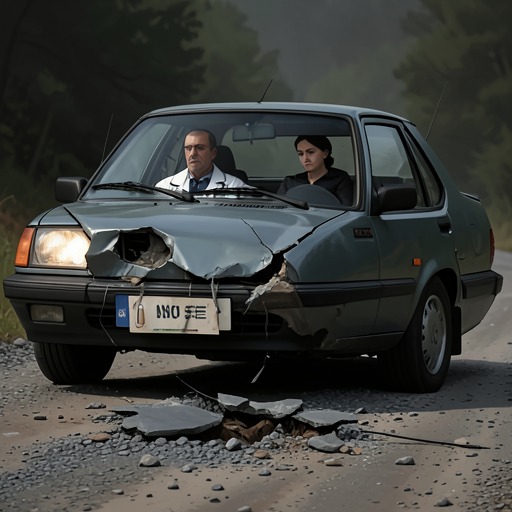
As evening falls, Doctor Sot sits in the trailer and drifts in and out of the moment. Someone gives him curried vegetables; he eats, and the food restores his sense enough for him to pick up his satchel and leave. Children, adults, and dogs are gathered around in the dark as he climbs into the Megane. Joxie remarks that the visit has been an education. The group laughs, and Doctor Sot laughs with them until he weeps. Still crying, he starts Elizabeth and drives her immediately into a ravine.
The crash abruptly ends the car’s role in the journey. Doctor Sot sobers at once from the impact, and the travellers help him out. The Megane’s remains smoke in the dark. He retrieves the remaining naggins and the chocolate cake he had bought for Sal but forgotten to give her, then sits on the hard-packed ground with a handkerchief pressed to his bleeding head. His brief lament for Elizabeth and Sal is followed by a feeling of relief like that accompanying the death of an old parent. The car’s wreck is therefore both a concrete consequence of the journey and an emotional release: Elizabeth had carried him up the mountain, but now he has lost the familiar, mother-named companion that had long endured his capers.
There is no immediate ride down. Joxie’s van has no lights, so Doctor Sot must remain until the following morning, when he can be brought down safely. The camp’s mobile phones make small points of light in the darkness. He calls Sal to tell her the bad news about Elizabeth. She is not alarmed that he is stranded on Slieve Bo; she is accustomed to his capers and disappearances, including occasions when he has spent days away and woken in ditches. He is shown into one of the rusted caravans for the night. The travellers go to bed early, leaving him among sleeping children and dogs, while he remains awake with a naggin and the untouched cake on his lap.
Visions and the Episode’s Significance
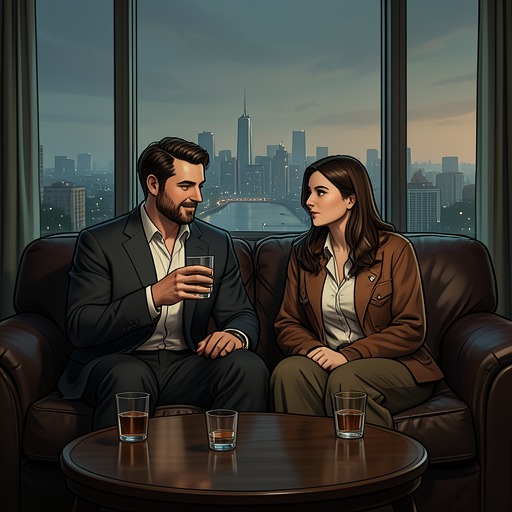
Unable to settle, Doctor Sot looks at the mirror fixed to a cupboard door. He approaches it cautiously, retreats, then approaches again. At first it is clear and shows no malevolence. On his third approach, a figure appears: Mag, outside the caravan, looking in and smiling. He goes to her. The narrative identifies the serenity of her smile as psychotic, but does not explain the visions or settle whether this encounter belongs to the same category. The mirror, which Doctor Sot already fears as a field of visions, makes the scene a direct return of the phenomenon he has been trying to contain with whiskey.
The episode’s significance lies in the friction between care and impairment. Doctor Sot leaves as a clinician, carrying the name of the North Western Health Board and offering health advice, but brings his concealed alcohol dependence with him. His effort to build trust becomes entangled with drinking; the informal hospitality that welcomes him also leaves him intoxicated, and the crash changes the planned visit into an enforced overnight stay. The travellers help him after the accident and provide shelter, while his wife accepts the disruption as familiar. Neither the outreach mission nor his professional standing protects him from the symptoms and decisions that shape the night.
The final image does not resolve the mystery of Doctor Sot’s visions. It moves from the practical aftermath of the crash—the ruined car, the call to Sal, and the need to wait for daylight—to an encounter that again tests the boundary between perception and hallucination. The visit therefore ends not with a completed medical intervention but with Doctor Sot inside a stranger’s caravan, facing a figure in the mirror after the ordinary means of escape have failed.